
Insights
Essential Electrical Systems & NFPA 99
When utility power fails in a hospital, the essential electrical system decides what stays alive and how fast. NFPA 99 and NEC Article 517 divide that system into three branches with different jobs, different transfer-time limits, and different rules for separation. This is a working contractor's guide to how those branches are structured, sourced, and proven out.
The essential electrical system and its three branches
The essential electrical system is the portion of a health care facility's power that must remain available when the normal source is lost. NFPA 99 and NEC Article 517 define it as an alternate-source system, backed by an on-site generator or equivalent emergency power supply, that automatically restores power to loads whose failure would endanger life, interrupt patient care, or compromise the safe operation of the building. It is engineered, wired, and inspected to a higher standard than the facility's normal distribution because lives depend on it behaving predictably during the worst moments.
In a Type 1 essential electrical system, the required system for hospitals, that power is divided into two systems and three branches. The emergency system comprises the life safety branch and the critical branch, and the equipment system comprises the equipment branch. Each branch is kept independent of the others in its wiring and overcurrent protection so that a fault or overload on one branch cannot pull down another. This separation is not a suggestion; NEC 517 requires that the branches be kept physically and electrically independent, in separate raceways and enclosures, from the normal system and from each other.
The reason for slicing the load this way is prioritization under a constrained source. A generator cannot instantaneously carry the entire building, so the code sequences restoration: the loads most immediately tied to human life come back first and fastest, and larger, less time-critical loads are brought on in controlled steps afterward. Understanding which load belongs on which branch is the foundational design decision in any hospital electrical project, and it drives everything downstream from transfer switch count to feeder routing.
Life safety branch, critical branch, and equipment system
The life safety branch carries only the loads that keep occupants safe during egress: illumination of exit paths and signs, exit and emergency egress lighting, fire alarm and detection, elevator cab lighting and the means to return elevators to a landing, alarm and alerting systems, and generator set accessories. NEC 517 strictly limits what may connect to this branch; nothing else is permitted on it, precisely so that the loads governing a safe evacuation can never be compromised by other demand. Life safety loads must be restored within ten seconds of normal power loss.
The critical branch serves the loads tied directly to patient care: task illumination and selected receptacles in operating rooms, delivery rooms, ICUs, and other critical care spaces; isolated power systems; nurse call; and the specific equipment whose loss would immediately threaten a patient. Like the life safety branch, the critical branch must be restored within ten seconds. The two branches together form the emergency system, and both are held to that ten-second transfer-time limit because the loads on them do not tolerate a longer gap.
The equipment system, fed by the equipment branch, carries the larger mechanical and support loads that must return after an outage but can tolerate a short, orderly delay: HVAC serving patient and critical spaces, medical vacuum and compressed air and other essential utility equipment, elevators, and heating for critical areas. These loads transfer on a delayed, sequenced basis after the emergency system is stable, either automatically after a short interval or by controlled steps, so the generator is not asked to accept every large motor at once. The staging protects the source and the transfer equipment while still restoring the full essential load within the time the facility can safely tolerate.
Transfer switches, generator sources, and paralleling
Automatic transfer switches (ATS) are the devices that sense the loss of normal power, signal the generator to start, and shift their loads to the alternate source once it is stable. In a Type 1 system the branches are served by separate transfer switches, or by a transfer switch with multiple independently controlled load segments, so that the life safety, critical, and equipment loads can be transferred and restored on their own schedules. Sizing, withstand rating, and the number of transfer switches all follow from how the load was divided among the branches and from the facility's tolerance for grouping loads on a single switch.
The alternate source is almost always one or more on-site diesel generators forming an emergency power supply system. Small facilities may use a single generator; larger hospitals parallel multiple generator sets onto a common bus so that capacity can be added, maintenance can be performed on one unit while others carry the load, and the loss of any single machine does not drop the essential system. Paralleling switchgear synchronizes the sets, manages load sharing, and sheds or adds load in steps as machines come online, which is also what makes the sequenced restoration of the equipment branch possible.
Fuel is part of the system, not an afterthought. NFPA 99 and NFPA 110 govern the on-site fuel supply, day tanks, and run-time so the generators can carry the essential load for the required duration, and the whole emergency power supply system, from fuel to switchgear to transfer switches, is treated as one coordinated assembly. Getting the source and the transfer scheme right is where hospital electrical work is genuinely different from commercial standby power, and it is unforgiving of shortcuts.
Type 1 versus Type 2 systems and selective coordination
NFPA 99 assigns a facility's required system type through a risk assessment based on the consequence of failure. Type 1 essential electrical systems, with the full life safety, critical, and equipment branch structure, are required where a power failure could cause major injury or death, which covers hospitals and most facilities performing invasive procedures or supporting patients incapable of self-preservation. Type 2 systems, a reduced arrangement, may be permitted for lower-acuity occupancies such as some nursing homes and limited-care facilities where the consequences of an outage are less severe. The risk category, not the building's name on the door, determines what must be built.
Selective coordination is a code requirement that shapes how the overcurrent protection on these systems is designed. NEC 517 and 700 require that the overcurrent devices on the emergency system be selectively coordinated, meaning that for a fault anywhere on the system, only the breaker or fuse immediately upstream of the fault opens, and every device above it stays closed. The intent is to contain a fault to the smallest possible zone so a short in one branch circuit cannot cascade and darken an entire critical branch. Achieving it requires a coordination study across the full range of fault currents and clearing times, and it constrains breaker types, settings, and sometimes the physical arrangement of the distribution.
For the contractor, coordination is not a paperwork exercise handed off to the engineer; it dictates what gets installed. Breaker frames, trip units, and fuse classes have to match the coordination study, and substituting an apparently equivalent device in the field can silently break coordination the design depended on. We build to the study as issued and flag any proposed substitution rather than let a value-engineering swap defeat a code-required protection scheme.
Commissioning, functional testing, and AHJ expectations
An essential electrical system is proven by test, not by inspection alone. Commissioning includes a full functional test in which normal power is intentionally dropped and the system is observed performing exactly as designed: the generator starts and reaches voltage and frequency, the life safety and critical branches restore within ten seconds, the equipment branch transfers on its sequenced delay, and everything returns to normal in the correct order when utility power is restored. Transfer times are measured and recorded, generator load acceptance is verified, and the paralleling and load-shed logic is exercised.
The testing obligation continues for the life of the building. NFPA 110 prescribes routine testing of the emergency power supply system, including a monthly operational test under load and a periodic extended load test, and NFPA 99 sets the maintenance and testing regime for the essential electrical system as a whole. We commission the system so it passes that first witnessed test cleanly and hand over the records the facility's ongoing testing program will build on, including transfer-time data, coordination documentation, and the sequence-of-operation the maintenance staff will run against.
The authority having jurisdiction and accrediting bodies such as the Joint Commission expect to see that documentation and to witness or review the functional testing. A hospital's environment-of-care program is surveyed against exactly these systems, so the commissioning records are not just a construction closeout, they become part of the facility's permanent compliance evidence. We build and document with that downstream survey in mind, so the essential electrical system is defensible long after the project closes.
How H&M approaches essential electrical systems
H&M Electric has installed essential electrical systems in occupied Washington hospitals and surgery centers for more than two decades. We self-perform the code-critical scope, the life safety, critical, and equipment branch distribution, the automatic transfer switches, the generator feeders, and the paralleling gear interfaces, and we build the branch separation NEC 517 requires so that a fault on one branch stays contained to that branch. Our project managers are fluent in what the code language means at the device level: how fast a branch must transfer, where a branch may and may not be bonded, and how to keep the emergency system independent of the normal source.
Most of this work happens in a live building with patients on the other side of the wall, so we plan outages, temporary power, and cutovers with the facilities team and sequence disruptive work into windows when a department can be safely taken down. We build to the coordination study as issued, flag substitutions rather than quietly defeat selective coordination, and commission the system so the first witnessed functional test and the first accreditation survey go smoothly. As an IBEW-signatory contractor, we bring the manpower and the documentation discipline this scope demands.
If you are planning or renovating a hospital, surgery center, or other facility that needs a Type 1 essential electrical system, and you want a contractor who understands the intent behind the three-branch structure rather than just the one-line, reach out. We are glad to walk a design and construction team through the constructability of the transfer scheme and the branch separation before the gear is released.
Essential electrical system capabilities
From the generator plant to the last critical-branch receptacle, H&M self-performs the scope a Type 1 essential electrical system depends on.
Life safety branch
Egress lighting, exit signs, fire alarm, and elevator loads on a dedicated branch restored within ten seconds, with nothing else permitted to share it.
Critical branch
Task lighting, selected receptacles, isolated power, and nurse call for critical-care spaces, restored within the same ten-second window.
Equipment system
HVAC, medical gas equipment, elevators, and support loads transferred on a sequenced delay so the source is not asked to accept them all at once.
Transfer switches
Automatic transfer switches sized, rated, and arranged per branch so each system transfers and restores on its own schedule.
Generator & paralleling interfaces
Emergency power supply feeders and paralleling-switchgear connections coordinated for redundancy, maintenance, and stepped load acceptance.
Coordination & commissioning
Installation built to the selective-coordination study, then functionally tested with measured transfer times and records for the AHJ and accreditation.
- Serving Washington since
- 1993Serving Washington since
- In healthcare & critical environments
- 20+ yrsIn healthcare & critical environments
- Emergency branch transfer-time limit
- 10 secEmergency branch transfer-time limit
- Essential systems built to code
- NFPA 99Essential systems built to code
Related work
All projects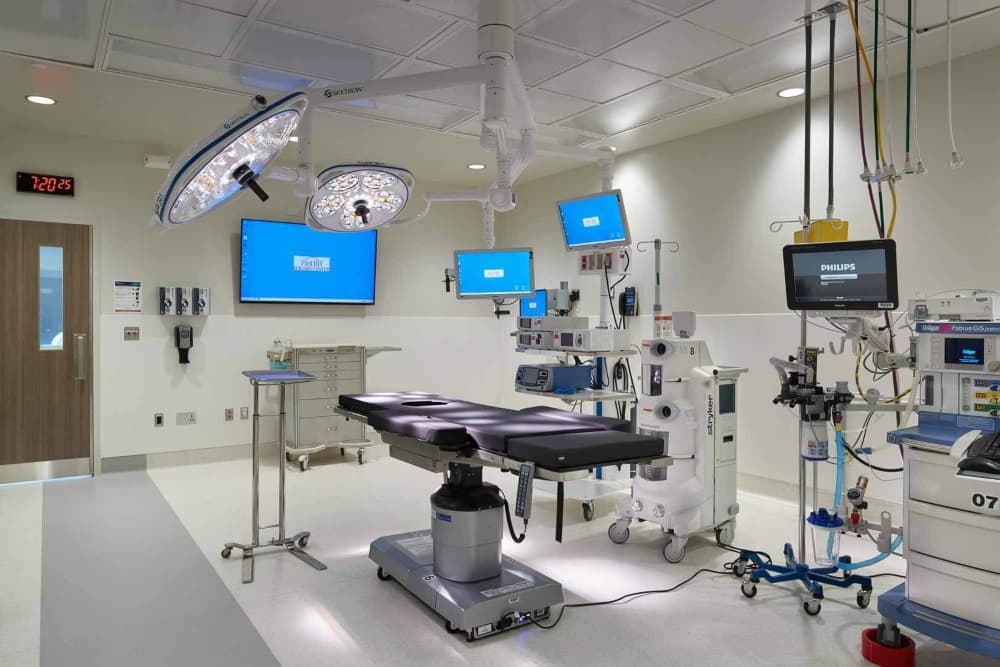 Healthcare & Critical Environments
Surgery center — operating rooms, PACU & sterile core
Fully equipped operating rooms with surgical booms and integrated power, plus post-anesthesia recovery (PACU) and a sterile processing core — the essential electrical systems a surgical suite depends on.
Hospital imaging & surgical center — EP labs, CT, MRI
Multi-phase work across a major hospital campus: electrophysiology labs, CT scanner and MRI suites, and an outpatient surgery center — executed in an occupied, operating facility.
Hospital specialty center — MRI & oncology
Specialty center including MRI, oncology, and physical-therapy spaces for an acute-care hospital.
Frequently asked
Questions buyers ask us
What is an essential electrical system?
An essential electrical system is the portion of a health care facility's power that must remain available when normal utility power is lost. Backed by an on-site generator or equivalent emergency power supply, it automatically restores power to loads whose failure would endanger life or interrupt patient care. NFPA 99 and NEC Article 517 govern how it is designed, built, and separated from the facility's normal distribution.
What are the three branches of a hospital essential electrical system?
A Type 1 system has three branches across two systems. The emergency system contains the life safety branch, which carries egress lighting, exit signs, fire alarm, and elevator loads, and the critical branch, which carries patient-care lighting, receptacles, isolated power, and nurse call. The equipment system contains the equipment branch, which carries HVAC, medical gas equipment, and other support loads on a sequenced delay. Each branch is kept independent in wiring and overcurrent protection.
How fast must emergency power transfer in a hospital?
The life safety branch and the critical branch, together the emergency system, must be restored within ten seconds of losing normal power. The equipment system transfers on a sequenced delay after the emergency system is stable, so large mechanical loads are added in controlled steps rather than all at once, protecting the generator and transfer equipment.
What is the difference between a Type 1 and Type 2 essential electrical system?
The type is set by an NFPA 99 risk assessment based on the consequence of a power failure. Type 1, with the full life safety, critical, and equipment branch structure, is required where an outage could cause major injury or death, which covers hospitals and most invasive-procedure facilities. Type 2 is a reduced arrangement permitted for lower-acuity occupancies such as some nursing and limited-care facilities.
What is selective coordination and why does it matter?
Selective coordination means that for a fault anywhere on the emergency system, only the overcurrent device immediately upstream of the fault opens while every device above it stays closed, containing the fault to the smallest zone. NEC 517 and 700 require it so a short on one branch circuit cannot cascade and darken an entire critical branch. It is proven by a coordination study and constrains the breaker frames, trip units, and settings that may be installed.
How is an essential electrical system tested and commissioned?
Commissioning includes a witnessed functional test where normal power is intentionally dropped and the system is observed performing as designed: the generator starts, the emergency branches restore within ten seconds, the equipment branch transfers on its delay, and everything returns in order when utility power comes back. Transfer times and load acceptance are measured and recorded. NFPA 110 then requires routine monthly load testing over the system's life, with records that feed the facility's accreditation program.
Bid invitations & estimates
Planning an essential electrical system?
We work with general contractors, healthcare facilities, developers, and property managers across Washington. Send plans and we'll respond quickly.