
Markets
Healthcare & Hospital Electrical Construction
For more than two decades H&M Electric has wired the environments where power is life-safety infrastructure — operating rooms, imaging suites, cath and EP labs, and the essential electrical systems that keep a hospital running when the utility does not. This is not general commercial work, and very few Washington contractors can credibly claim the depth of critical-environment experience we bring to it.
Essential electrical systems built to NFPA 99 and NEC Article 517
Hospitals do not tolerate the outages that most commercial buildings shrug off. Under NFPA 99 and NEC Article 517, a healthcare facility's essential electrical system is divided into a life safety branch, a critical branch, and an equipment system — each with its own transfer scheme, its own load priorities, and strict limits on transfer time. H&M Electric designs, installs, and commissions these systems so that anesthesia, monitoring, egress lighting, and life-support loads ride through a utility failure without interruption.
That work runs from the incoming service and paralleling switchgear down to the branch panels feeding a single patient bay. We coordinate automatic transfer switches, generator paralleling, and load sequencing with the engineer of record, then prove the system through documented functional testing. The goal is not simply a code-compliant install — it is a facility that transfers cleanly, holds its critical loads, and passes the authority having jurisdiction and Joint Commission scrutiny the first time.
Because the essential electrical system touches every department, we plan feeder routing, panel locations, and branch separation early, when they can still be optimized against the architecture and the equipment schedule. Getting the topology right up front is what keeps a healthcare project on schedule through activation.
Isolated power, wet procedure locations, and patient-care spaces
In operating rooms and other wet procedure locations, a single ground fault cannot be allowed to shut down a case in progress. Isolated power systems, monitored by line isolation monitors, keep procedures energized while continuously reporting insulation integrity — the difference between an alarm the surgical team can respond to and a room that goes dark mid-procedure. H&M installs and tests isolated power panels, reference grounding, and equipotential bonding to the tolerances these spaces demand.
Patient-care space classification drives everything downstream: redundant grounding paths, the number and type of receptacles per bed location, and the branch each device belongs to. We build to the specific category of care each room supports, document our grounding-system resistance testing, and hand over records that facilities engineers can stand behind for the life of the space.
This is exacting, code-dense work where the margin for error is effectively zero. It is also the core of what H&M has done for over twenty years in the operating rooms and procedure suites of Puget Sound.
Imaging: MRI, CT, angiography, and radiation oncology
Imaging suites are among the most demanding electrical environments in any building. MRI installations require careful management of the magnetic field and RF-shielded enclosures — conduit penetrations, waveguides, filtered power, and grounding all have to respect the shield and the fringe field, or the scanner will not perform. We coordinate directly with imaging vendors and shield manufacturers so the electrical work supports, rather than compromises, image quality.
CT and angiography suites bring their own heavy power demands, dedicated distribution, and equipment-vendor sequences that have to align with the construction schedule. In radiation oncology, linear-accelerator vaults add shielded penetrations, interlock and safety systems, and coordination with massive concrete pours that leave no room for a missed sleeve or conduit. H&M has delivered imaging and radiation-oncology environments across the region and understands how tightly the electrical scope is bound to the equipment.
The through-line across all imaging work is vendor coordination. The scanner, the shield, the engineer, and the contractor all have to move in lockstep, and we manage those interfaces so activation is not the moment problems surface.
Cath and EP labs, and the reality of working in occupied hospitals
Electrophysiology and cardiac catheterization labs concentrate high-value equipment, procedural power, and life-safety requirements into a single room. H&M has built cath and EP labs where the electrical scope had to satisfy the equipment vendor, the essential electrical system, and the clinical workflow at once — dedicated circuits, isolated power where required, and integration with imaging and hemodynamic systems.
Most healthcare electrical work happens inside a hospital that never closes. Renovations and additions proceed floor by floor while patients are being treated on the other side of a temporary barrier. That reality governs how we sequence, when we schedule outages, and how we protect the occupied environment. Every infection-control risk assessment (ICRA) drives negative-pressure containment, HEPA filtration, and traffic control that our crews respect as a condition of the work, not an afterthought. When the work affects life-safety features, we plan to the facility's Interim Life Safety Measures (ILSM) as well, coordinating with the Safety and Environment-of-Care committees so egress, alarm, and suppression coverage hold throughout construction.
Phased tie-ins, temporary power, and tightly choreographed shutdowns of live systems are routine for us. We plan each transition with the facilities team so that a renovation never puts an occupied unit at risk, and so that the hospital keeps operating at full capacity while we build the next generation of its infrastructure.
Healthcare electrical capabilities
Full-scope electrical construction for hospitals, surgery centers, and specialty clinics — from the incoming service to the last isolated-power receptacle.
Essential electrical systems
Life safety, critical, and equipment branches designed, installed, and functionally tested to NFPA 99 and NEC Article 517, with generators, paralleling switchgear, and automatic transfer coordination.
Isolated power systems
Isolated power panels, line isolation monitors, reference grounding, and equipotential bonding for operating rooms and other wet procedure locations.
MRI & imaging suites
RF-shield-aware installations for MRI, plus dedicated distribution for CT and angiography, coordinated directly with imaging and shield vendors.
Cath & EP labs
Procedural power, dedicated circuits, and equipment integration for electrophysiology and cardiac catheterization suites.
Radiation oncology vaults
Linear-accelerator power, shielded penetrations, and interlock and safety-system wiring coordinated with heavy concrete construction.
Occupied-facility phasing & ICRA
Phased tie-ins, temporary power, and live-system shutdowns executed under infection-control containment in hospitals that never close.
- Healthcare & critical-environment electrical work
- 20+ yrsHealthcare & critical-environment electrical work
- Essential electrical systems & Article 517 expertise
- NFPA 99Essential electrical systems & Article 517 expertise
- Emergency response within one day
- 24/7Emergency response within one day
- IBEW-signatory contractor serving Washington
- 1993IBEW-signatory contractor serving Washington
Related work
All projectsHealthcare & Critical EnvironmentsSurgery center — operating rooms, PACU & sterile core
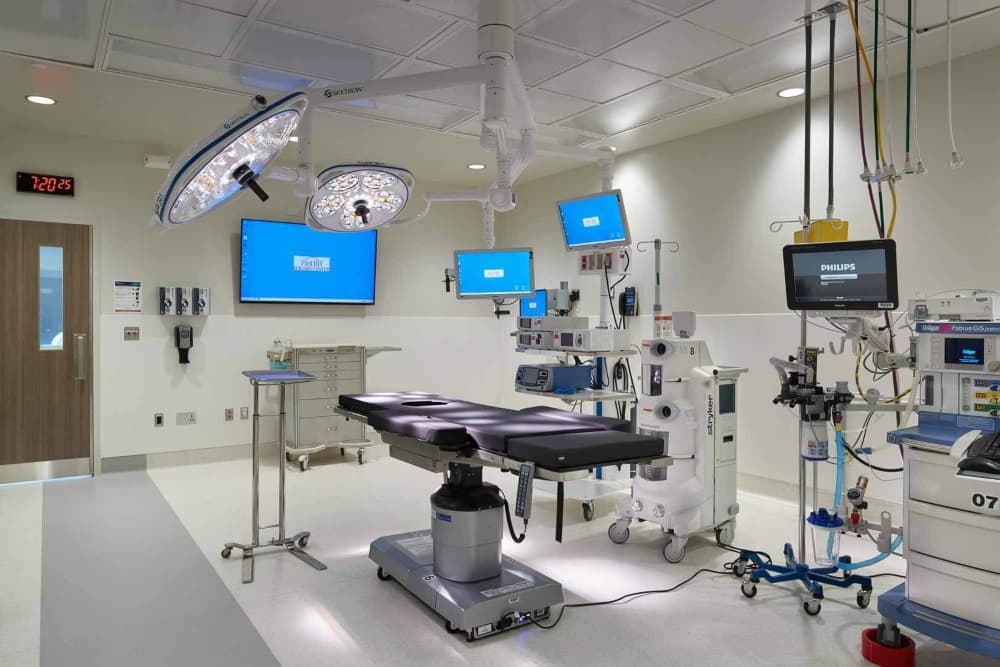
Fully equipped operating rooms with surgical booms and integrated power, plus post-anesthesia recovery (PACU) and a sterile processing core — the essential electrical systems a surgical suite depends on.
 Healthcare & Critical Environments
Heart & vascular center — EP and cath labs
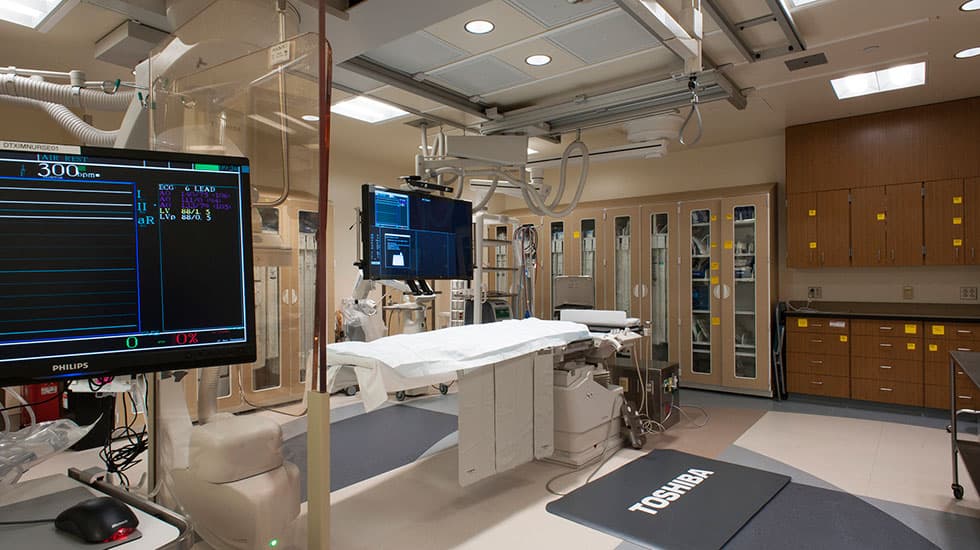
Electrophysiology and cardiac catheterization labs with ceiling-mounted imaging systems, isolated power, and the equipotential grounding these interventional-cardiology spaces require.
 Healthcare & Critical Environments
Radiation oncology — linear accelerator (LINAC) vault
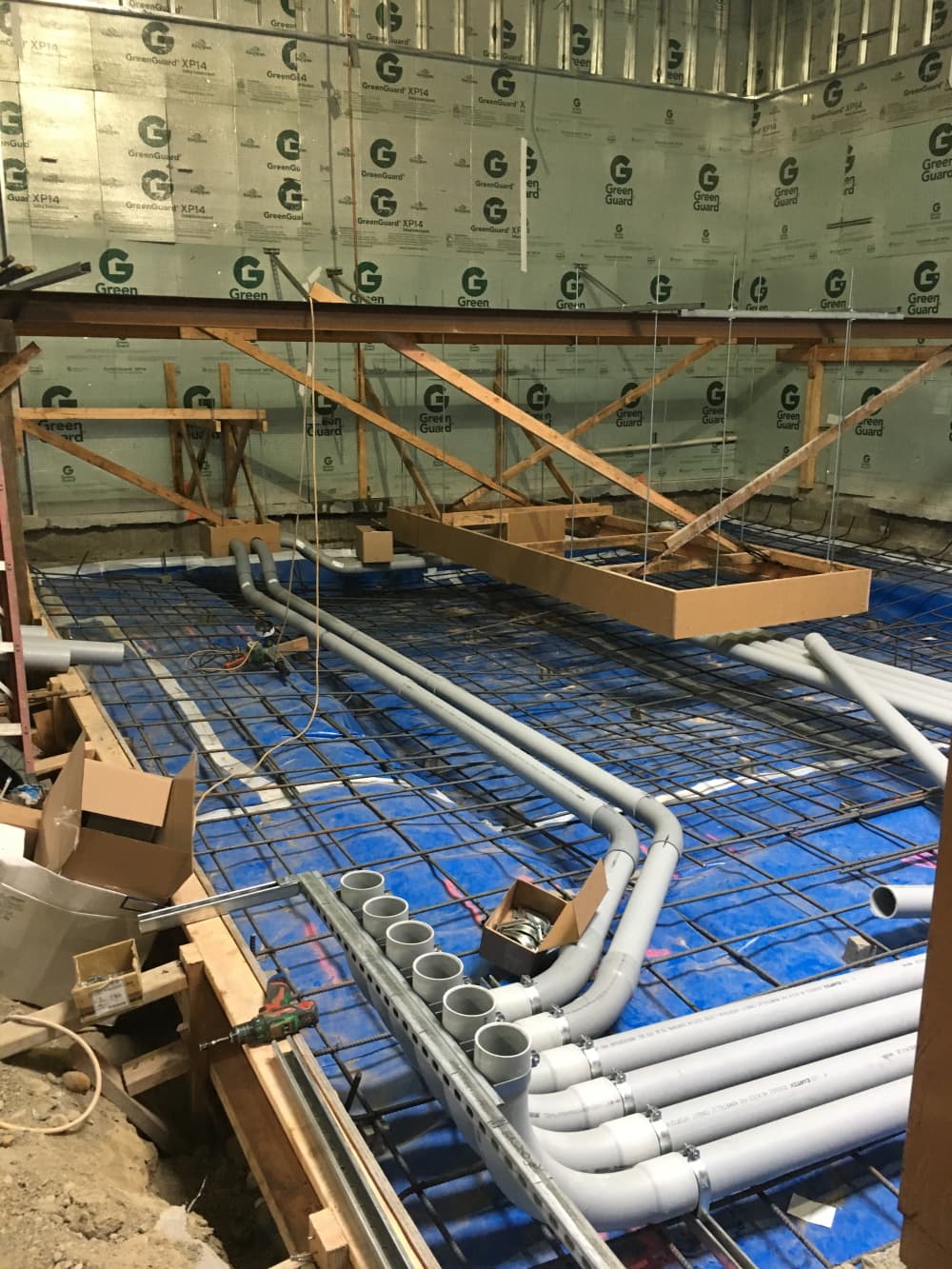
Underground conduit rough-in and power distribution for a shielded linear-accelerator vault — high-stakes coordination beneath the concrete radiation shielding of an oncology suite.
Hospital imaging & surgical center — EP labs, CT, MRI
Multi-phase work across a major hospital campus: electrophysiology labs, CT scanner and MRI suites, and an outpatient surgery center — executed in an occupied, operating facility.
Hospital CT, angiography & RF room build-out
Phased CT installation, angiography suite, an RF-shielded room, and mechanical HVAC power upgrades within an active hospital.
Hospital specialty center — MRI & oncology
Specialty center including MRI, oncology, and physical-therapy spaces for an acute-care hospital.
Frequently asked
Questions buyers ask us
What is an essential electrical system in a hospital?
An essential electrical system is the code-mandated backup power scheme that keeps critical hospital functions running during a utility outage. Under NFPA 99 and NEC Article 517 it is divided into three parts — the life safety branch, the critical branch, and the equipment system — each fed through automatic transfer switches from an on-site generator source, with defined load priorities and transfer times.
What is an isolated power system and where is it required?
An isolated power system provides ungrounded power monitored by a line isolation monitor, so that a single ground fault triggers an alarm instead of an outage. It is used in wet procedure locations such as operating rooms, where interrupting power mid-procedure is unacceptable, allowing the clinical team to respond to a fault without losing the room.
Can electrical work be done in an occupied, operating hospital?
Yes. The majority of hospital electrical work happens in occupied facilities. It requires phased construction, an infection-control risk assessment (ICRA) that dictates containment, negative pressure, and HEPA filtration, and carefully scheduled shutdowns of live systems so that patient care continues uninterrupted while renovations proceed behind temporary barriers.
What is special about electrical work for an MRI suite?
An MRI suite combines a strong magnetic field with an RF-shielded enclosure. Electrical work must respect the shield through filtered power, proper waveguide penetrations, and grounding, and must account for the fringe magnetic field. Close coordination with the imaging and shield vendors is essential so the installation supports rather than degrades image quality.
Does H&M Electric coordinate with imaging and equipment vendors?
Yes. Imaging, cath/EP lab, and radiation-oncology projects are bound tightly to equipment vendors. H&M coordinates power requirements, penetrations, and installation sequences directly with vendors and the engineer of record so equipment activation proceeds on schedule without surprises.
Why does healthcare electrical work require a specialized contractor?
Healthcare electrical construction is governed by NFPA 99 and NEC Article 517, involves life-safety and isolated power systems, imaging and radiation environments, and near-constant work in occupied facilities. It is materially different from general commercial work, and H&M brings more than twenty years of dedicated critical-environment experience to it.
Bid invitations & estimates
Planning a hospital project? Bring the electrical team in early.
We work with general contractors, healthcare facilities, developers, and property managers across Washington. Send plans and we'll respond quickly.