
Services
Commercial EV Charging Infrastructure
Electric vehicle charging is only as reliable as the power distribution behind it. H&M Electric builds commercial and fleet charging infrastructure — from Level 2 workplace ports to DC fast-charging depots — on more than thirty years of switchgear, service, and critical-power experience. This is the emerging, electrification-driven work we are moving into, and exactly the kind of power infrastructure H&M was built to deliver.
Level 2 and DC fast charging for commercial sites
Commercial charging spans a wide range, and the right mix depends on how a site is used. Level 2 charging suits workplaces, multifamily properties, and retail destinations where vehicles dwell for hours, delivering a steady charge across many ports at a manageable cost per stall. DC fast charging serves fleets, transit, and high-turnover public sites where vehicles need to be back on the road in minutes, at the cost of far heavier power demand and more complex equipment.
H&M installs both, and — just as importantly — helps owners choose the right balance before the first conduit is bent. The number of ports, their power levels, and the way they share available capacity drive everything downstream, from the service size to the switchgear to the trenching and pad work. Getting that topology right up front is what keeps a charging project on budget and out of costly rework.
Because charging equipment comes from many manufacturers with their own requirements, we coordinate directly with charger vendors on power, mounting, networking, and commissioning so the hardware energizes on schedule and performs to spec. The charger is the visible piece; the distribution behind it is where reliability is won or lost.
Workplace, multifamily, and retail charging
For workplaces, multifamily communities, and retail centers, EV charging has shifted from amenity to expectation. These sites reward a strategy that scales: a distribution and conduit design that serves the ports needed today while leaving capacity and pathways for the ports a property will want in a few years, without re-trenching a parking lot to add them.
H&M designs charging for these environments around real-world use — how long vehicles dwell, how many charge at once, and how the load fits the building's existing service. Networked chargers add access control, payment, and usage data for property managers, and load management keeps the aggregate demand within the service so a full lot never trips the building. We build the infrastructure so the property owner's investment grows with demand rather than being capped by day-one decisions.
Fleet and transit charging depots
Fleet electrification is the most demanding form of commercial charging. A depot that returns dozens of vehicles to charge overnight concentrates enormous power in one place, and the electrical infrastructure — service, switchgear, distribution, and often on-site transformation — becomes the backbone the operation depends on. Downtime is not an inconvenience; it is vehicles that cannot run their routes.
This is where H&M's three decades of industrial power-distribution and critical-power experience translate directly. Depot charging is a switchgear and distribution project as much as a charger project, and it demands the same discipline we bring to data-center and standby-power work: right-sized service, robust distribution, sequenced energization, and load management that shapes charging to the utility's capacity and the fleet's schedule.
We plan depots for the reality of the operation — charging windows, duty cycles, future vehicle counts, and the phased growth most fleets undergo. Building headroom and flexibility into the infrastructure now is what lets a depot add vehicles later without rebuilding the electrical spine.
Service upgrades, switchgear, and make-ready infrastructure
Most charging projects live or die on capacity. Adding meaningful charging load to an existing building often means upgrading the service, adding or reworking switchgear, and extending distribution to where the vehicles park — the electrical backbone that has to be in place before a single charger is mounted. This make-ready infrastructure is the heart of commercial EV work, and it is squarely H&M's wheelhouse.
Make-ready done well is make-ready done once. We size the service and gear for a realistic growth curve, run the conduit and distribution to support future ports, and stub out capacity so an owner can add chargers over time by connecting to infrastructure that is already there. That approach turns a series of expensive one-off additions into a single, planned build-out.
Because H&M carries panels, feeders, switchgear, and service upgrades as everyday work, the make-ready scope is not a subcontracted unknown — it is the core of what we do, delivered by the same team that will stand behind the finished system.
Load management, networking, utility coordination, and incentives
Intelligent load management is what makes commercial charging affordable and reliable. Networked chargers can share a fixed amount of power across many ports, throttle charging during peak periods, and prioritize vehicles by need, so an owner installs the ports they want without paying for a service upgrade sized to every charger running at full power at once. We design and configure these systems so the aggregate load stays within the service and the utility's limits.
Utility coordination and interconnection are woven through every serious charging project. New load has to be reviewed, approved, and often supported by utility-side upgrades, and the timeline for that work frequently governs the project schedule. H&M manages the interconnection process alongside the construction so utility approvals and field work move together rather than one stalling the other.
Charging infrastructure is also supported by a range of utility, state, and federal incentive and rebate programs that can meaningfully offset the cost of make-ready work and equipment. Program details and funding change over time, so we help owners understand the general landscape and build projects that are positioned to qualify — while pointing to the administering agencies for current specifics rather than promising particular amounts.
Emerging work, proven power experience — get an estimate
EV charging is part of H&M's move into emerging, electrification-driven work, alongside data-center critical power and other high-demand infrastructure. What makes that move credible is not novelty but track record: reliable charging is fundamentally a power-distribution problem, and distribution is what H&M has done as an IBEW-signatory contractor since 1993. Serving all of Washington from a core footprint across Snohomish and King counties, with licensing underway in Idaho, we bring the switchgear and service depth this work actually requires.
Whether you are a fleet or site operator electrifying a depot, a developer wiring a new property for charging, or a facilities director adding ports to an existing lot, the earlier we join the project, the more we can do — sizing the service for where you are headed, sequencing the utility work, and building make-ready infrastructure that grows with demand. Reach out for an estimate and let's scope charging infrastructure that will still be reliable years after it is energized.
Commercial EV charging capabilities
End-to-end charging infrastructure from the utility service to the last port — engineered for reliability and built to scale with demand.
Level 2 & DC fast charging
Workplace, multifamily, retail, and public charging from steady Level 2 ports to high-power DC fast charging, coordinated directly with charger vendors.
Fleet & transit depots
High-density depot charging backed by industrial-grade service, switchgear, and distribution sized for duty cycles and phased fleet growth.
Make-ready infrastructure
Service, switchgear, conduit, and distribution built once to support both today's ports and the ports a site will add over time.
Service & switchgear upgrades
Capacity upgrades, panel and feeder work, and switchgear additions delivered as core, self-performed electrical scope.
Load management & networking
Networked chargers with intelligent load sharing, peak throttling, access control, and usage data that keep aggregate demand within the service.
Utility coordination & incentives
Interconnection managed alongside construction, plus guidance on the incentive and rebate landscape so projects are positioned to qualify.
- Power-distribution & switchgear experience
- 30+ yrsPower-distribution & switchgear experience
- Level 2 through DC fast charging
- L2 & DCFCLevel 2 through DC fast charging
- Emergency response within one business day
- 24/7Emergency response within one business day
- IBEW-signatory contractor serving Washington
- 1993IBEW-signatory contractor serving Washington
Related work
All projectsTelecom switch & data center electrical
Critical-power electrical for a telecommunications switch and data center, plus ongoing service-division support.
 Technology & Evolving Industries
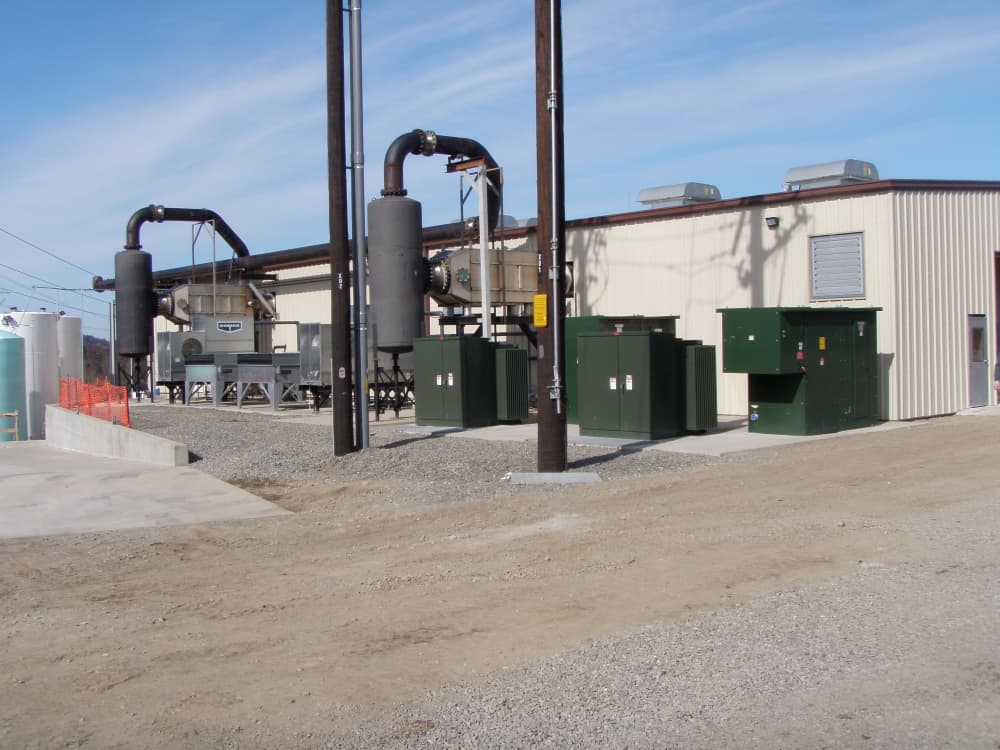
Landfill-gas bio-energy facility
Design-build electrical for a landfill-gas-to-energy facility — pad-mounted transformers, gas-processing power, and controls for a specialized industrial environment.
Frequently asked
Questions buyers ask us
What is the difference between Level 2 and DC fast charging?
Level 2 charging delivers a steady charge over several hours and suits workplaces, multifamily properties, and retail sites where vehicles dwell. DC fast charging delivers a much faster charge for fleets, transit, and high-turnover public sites, but draws far more power and requires heavier service, switchgear, and distribution. The right mix depends on how vehicles use the site.
What does EV make-ready infrastructure mean?
Make-ready is the electrical backbone installed before chargers are mounted — the service capacity, switchgear, conduit, and distribution that bring power to where vehicles park. Building make-ready for future growth lets an owner add ports over time by connecting to infrastructure that is already in place, rather than re-trenching for each expansion.
Will EV charging require a service or switchgear upgrade?
Often, yes. Adding meaningful charging load to an existing building can exceed its available capacity, requiring a service upgrade, additional or reworked switchgear, and extended distribution. H&M performs this work as core electrical scope and sizes it for realistic growth so the upgrade is done once rather than repeatedly.
How does load management reduce EV charging costs?
Networked chargers with load management share a fixed amount of power across many ports, throttle during peak periods, and prioritize vehicles by need. This lets an owner install the ports they want without paying for a service sized to run every charger at full power simultaneously, keeping aggregate demand within the existing service where possible.
Are incentives or rebates available for commercial EV charging?
A range of utility, state, and federal incentive and rebate programs can offset the cost of make-ready infrastructure and charging equipment. Program details and funding change over time, so H&M helps owners understand the general landscape and build projects positioned to qualify, while pointing to the administering agencies for current specifics.
Does H&M coordinate utility interconnection for charging projects?
Yes. New charging load must be reviewed and approved by the utility, and utility-side upgrades can govern the schedule. H&M manages the interconnection process alongside construction so approvals and field work move together, and applies more than thirty years of power-distribution experience to size and sequence the project.
Bid invitations & estimates
Electrifying a site or fleet? Get an EV charging estimate from H&M.
We work with general contractors, healthcare facilities, developers, and property managers across Washington. Send plans and we'll respond quickly.