
Company
Safety
Safety is how H&M Electric works, not a policy on a wall. Every worker leaves the job the way they arrived — that commitment shapes how we plan tasks, energize systems, and build inside facilities full of patients and the public. It is a culture our crews own, a program our leadership backs, and a practice we hold to on every site.
A safety-first culture, backed by leadership
A safety program only works when the whole company believes in it, from the owner to the newest apprentice. At H&M, leadership sets the expectation that no schedule, no budget, and no client pressure justifies putting a worker at risk — and then backs that expectation with the time, training, and equipment to make it real. When the people signing the checks mean it, the field can trust it.
That commitment is visible in the small things as much as the large ones: crews are expected to stop work when something is not right, and raising a concern is treated as doing the job well, not slowing it down. Stop-work authority belongs to everyone on the crew, and no one is second-guessed for using it. A culture where the newest worker can halt an unsafe task is a culture that keeps people whole.
We reinforce that culture continuously — in hiring, in onboarding, in daily conversations on site — so safety is simply how H&M people work, on the first day of a project and the last.
IBEW-trained, qualified electrical workers
As an IBEW-signatory contractor, H&M staffs its projects with electricians trained through one of the most rigorous apprenticeship and journeyman programs in the trade. That training is not only about installation quality — it is where electrical workers learn to recognize hazards, work qualified around energized equipment, and apply the safety standards the trade is built on.
A qualified worker, in the language of the codes and standards that govern electrical work, is someone with the training and demonstrated skill to understand the hazards of the equipment and the methods to work around them safely. H&M builds its crews from qualified people and keeps their training current, so the person on the tools understands not just how to make the connection but how to do it without becoming the fault path.
Ongoing training keeps skills and hazard awareness sharp as codes, equipment, and methods evolve — because a program is only as strong as the knowledge of the people executing it.
Job hazard analysis and daily pre-task planning
Most incidents are prevented long before the tools come out — in the planning. H&M plans work through job hazard analysis, breaking a task into its steps, identifying the hazards in each, and putting controls in place before the work begins. Thinking through what could go wrong, and how to prevent it, is the single most effective safety practice on any site.
That planning carries into every shift through daily pre-task planning and toolbox talks. Before a crew starts, they walk the task together: what is being done, what has changed on the site since yesterday, what hazards are present, and what protections are required. It is a short conversation with an outsized effect, because it puts the whole crew on the same page about the risks in front of them and keeps safety a daily habit rather than an annual training.
Site-specific plans and OSHA/WISHA compliance
Every project gets a site-specific safety plan built for its actual conditions — its hazards, its logistics, its coordination with other trades, and the requirements of the owner and the facility. A generic binder does not keep anyone safe; a plan written for the real site does. We build ours to meet and align with federal OSHA and Washington's WISHA requirements, and we hold the field to them.
Compliance is the floor, not the ceiling. Meeting the regulatory standard is where H&M starts, and our field leadership is responsible for making sure the plan is followed, the required protections are in place, and conditions are corrected when they drift. We coordinate our safety planning with the general contractor and the other trades so that a shared site is a safe site for everyone working in it, not just for our own crews.
Electrical-specific safety: NFPA 70E, arc flash, and lockout/tagout
Electrical work carries hazards no other trade faces — shock, arc flash, and arc blast — and it demands its own discipline. H&M works to NFPA 70E, the standard for electrical safety in the workplace, applying it to how we assess risk, establish safe work conditions, and protect workers around energized equipment.
The first rule is to work de-energized whenever it is feasible. Our crews establish an electrically safe work condition through lockout/tagout — verifying isolation and absence of voltage before hands go on the equipment — so the default is a circuit that cannot come alive unexpectedly. When a task genuinely cannot be performed de-energized, it is treated as the exception it is: an energized-work permit, an arc-flash risk assessment, appropriate boundaries, and the correct arc-rated PPE and insulated tools for the incident energy present.
Arc-flash hazard is respected, labeled, and planned for rather than assumed away. Approaching energized equipment with the wrong protection is one of the gravest risks in the trade, and H&M's practice is built specifically to keep our people outside that danger.
Working safely in occupied and critical facilities
Much of H&M's work happens in buildings that never close — hospitals with patients on the other side of the wall, and public buildings that stay open to the people who depend on them. In those settings safety extends past our own crews to the occupants around the work, and planning has to account for both.
In healthcare, we plan and execute to Infection Control Risk Assessment (ICRA) requirements, maintaining barriers, negative pressure, and clean routing so construction never carries dust or disruption into patient care areas. We coordinate outages, temporary power, and cutovers with the facilities team so critical branches are never dark, performing disruptive work in the windows when a department can be safely taken down. In occupied public buildings, we sequence and barricade the work to keep the public safely separated from it while the building keeps operating.
Working safely inside a running critical facility is a discipline of its own — one H&M has practiced for more than twenty years in healthcare and critical environments, where the safety of the people we build around matters as much as the safety of the people building.
How safety works at H&M
Program, culture, and daily practice reinforce each other, so safe work is the way the job gets done — not a document filed away.
Leadership commitment
Ownership and management back the program with training, time, and equipment, and stop-work authority belongs to everyone on the crew.
Qualified, IBEW-trained crews
Electricians trained through rigorous IBEW apprenticeship and journeyman programs, with hazard recognition and safe methods kept current.
Job hazard analysis
Tasks broken into steps and their hazards controlled before work begins, so incidents are prevented in the planning rather than managed in the field.
Daily pre-task planning & toolbox talks
Crews walk the task, the changes, and the hazards together before every shift, keeping safety a daily habit instead of an annual training.
NFPA 70E & lockout/tagout
Work de-energized by default through verified lockout/tagout, with arc-flash risk assessment, energized-work permits, and arc-rated PPE when it is unavoidable.
Occupied & critical-facility safety
ICRA-driven infection control, coordinated outages, and public separation that protect occupants in hospitals and public buildings that stay open.
- Building safely in Washington since
- 1993Building safely in Washington since
- Signatory — trained, qualified electrical workers
- IBEWSignatory — trained, qualified electrical workers
- Electrical safety practice, arc flash and LOTO
- NFPA 70EElectrical safety practice, arc flash and LOTO
- Working safely in occupied critical facilities
- 20+ yrsWorking safely in occupied critical facilities
Related work
All projects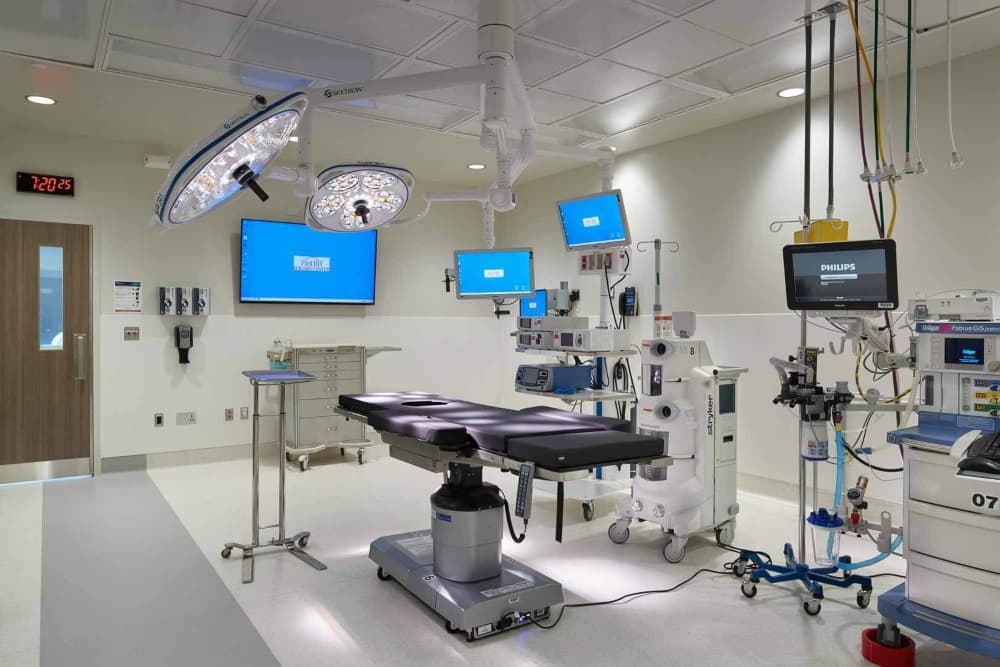 Healthcare & Critical Environments
Surgery center — operating rooms, PACU & sterile core
Fully equipped operating rooms with surgical booms and integrated power, plus post-anesthesia recovery (PACU) and a sterile processing core — the essential electrical systems a surgical suite depends on.
Hospital imaging & surgical center — EP labs, CT, MRI
Multi-phase work across a major hospital campus: electrophysiology labs, CT scanner and MRI suites, and an outpatient surgery center — executed in an occupied, operating facility.
Frequently asked
Questions buyers ask us
How does H&M approach safety on a project?
H&M treats safety as culture, program, and daily practice together. Leadership backs the program, crews are IBEW-trained and qualified, work is planned through job hazard analysis and daily pre-task planning, and every project runs to a site-specific plan aligned with OSHA and WISHA requirements.
What is NFPA 70E and how does H&M apply it?
NFPA 70E is the standard for electrical safety in the workplace. H&M applies it to assess electrical risk, establish electrically safe work conditions, and protect workers around energized equipment through arc-flash risk assessment, defined boundaries, and correct arc-rated PPE.
Does H&M work on energized equipment?
The default is to work de-energized, establishing an electrically safe condition through lockout/tagout with verified isolation and absence of voltage. Energized work is treated as an exception requiring an energized-work permit, an arc-flash risk assessment, and appropriate PPE and insulated tools for the incident energy present.
What is a job hazard analysis?
A job hazard analysis breaks a task into its steps, identifies the hazards in each step, and puts controls in place before work begins. It is paired with daily pre-task planning and toolbox talks so the whole crew shares the same understanding of the risks in front of them each shift.
How does H&M keep patients and the public safe during construction?
In occupied buildings, safety extends to the people around the work. In healthcare, H&M plans to Infection Control Risk Assessment (ICRA) requirements with barriers, negative pressure, and clean routing, and coordinates outages so critical branches stay energized. In public buildings, work is sequenced and barricaded to keep the public safely separated while the facility stays open.
Are H&M's electricians trained for hazardous electrical work?
Yes. As an IBEW-signatory contractor, H&M staffs projects with electricians trained through rigorous apprenticeship and journeyman programs, where they learn to recognize hazards and work qualified around electrical systems. Their training and hazard awareness are kept current as codes, equipment, and methods evolve.
Bid invitations & estimates
Safety is how we build. Let's talk about your project.
We work with general contractors, healthcare facilities, developers, and property managers across Washington. Send plans and we'll respond quickly.