
Insights
Isolated Power Systems in Healthcare Facilities
In operating rooms and other wet procedure locations, a single ground fault should never darken a case or endanger a patient. Isolated power systems make that possible by keeping the supply ungrounded and continuously monitored. This is a working contractor's guide to how they are designed, installed, and commissioned under NEC Article 517.
What an isolated power system is and why ungrounded power matters
An isolated power system (IPS) delivers electricity to a patient-care area through an isolation transformer whose secondary is deliberately not referenced to ground. In a conventional grounded system, the first fault from a live conductor to a grounded surface completes a circuit, drives fault current, and either trips a breaker or energizes anything a patient or clinician might touch. In an ungrounded secondary, that same first fault has no low-impedance return path, so it does not draw hazardous current and does not open the circuit. Power to the procedure continues while the fault is annunciated for correction.
The clinical rationale is patient safety in the presence of liquids and invasive contact. In a wet procedure location, irrigation fluids, blood, and saline lower skin and contact resistance, and catheters or electrodes can place the low-resistance path directly across or near the heart. Microshock currents that would be imperceptible on dry, intact skin can induce ventricular fibrillation when delivered through an intracardiac catheter. Ungrounded distribution limits the current that a single fault can drive through such a path to a value well below the fibrillation threshold.
The trade for that safety is that a fault does not announce itself by tripping. An undetected first fault silently converts the system back into a grounded one, so that a subsequent second fault would then behave like a normal short circuit. Isolated power is therefore never installed without continuous monitoring. The isolation transformer and the line isolation monitor are a matched pair, and neither functions as intended without the other.
The line isolation monitor and total hazard current
The line isolation monitor (LIM) is the instrument that makes an ungrounded system safe to rely on. It continuously measures the electrical impedance from each isolated conductor to ground and computes the total hazard current, the current that would flow through a person of defined resistance who bridged the most heavily faulted conductor to ground. Modern dynamic monitors sense the true resistive and capacitive leakage without themselves adding meaningful hazard current, an improvement over the older static monitors they replaced.
NEC 517.160 requires the monitor to alarm before the total hazard current reaches a value that would present a hazard, with a green lamp indicating a safe condition and a red lamp plus an audible signal indicating that the hazard current has reached the trip threshold. In the United States that threshold is typically 5 mA for the standard monitor; the alarm signals a degraded condition, not an automatic disconnection. Staff are trained that a red LIM alarm means the last piece of equipment plugged in is the likely offender and should be removed, while the case continues on the equipment that remains.
It is essential that clinical and facilities staff understand the alarm is informational, not a command to shut down. The whole point of isolated power is procedural continuity: the system keeps delivering power through the first fault precisely so a surgeon is never forced to stop. A remote annunciator with the same green and red indication and hazard-current readout is installed at a location visible to staff in the procedure room, so the condition of the system is always in view.
Wet procedure locations and where NEC Article 517 requires isolated power
NEC Article 517 governs electrical construction in health care facilities, and the requirement for isolated power hinges on how a space is classified. A wet procedure location is a patient-care space where fluids, cleaning solutions, or bodily liquids are routinely present at the patient vicinity during examination or treatment. Operating rooms are the classic example, but many cystoscopy, endoscopy, cardiac catheterization, and electrophysiology spaces are also wet procedure locations depending on the practice.
The code does not automatically mandate isolated power for every wet location. NEC 517.20 requires that a wet procedure location be protected either by isolated power with a line isolation monitor or by ground-fault circuit-interrupter (GFCI) protection, unless a governing body's documented risk assessment determines the space is not a wet procedure location. The distinction between the two protective methods is fundamentally about interruption. GFCI protection trips on the first fault and de-energizes the circuit; isolated power tolerates the first fault and keeps the lights on. Where an unexpected loss of power would itself introduce a hazard, such as an operating room in the middle of a procedure, isolated power is the appropriate and near-universal choice.
That risk assessment is a design decision made by the facility's governing body, not by the electrical contractor alone, and it must be documented. Our role is to inform it: to help the owner and engineer understand what each protection method means for continuity and code compliance, and then to build precisely what the assessment calls for. Getting the classification right early avoids the far more expensive path of discovering during commissioning that a space needed isolated power it was never designed to receive.
Isolated power panels, transformers, and equipotential grounding
A complete isolated power system is more than a transformer. It comprises the isolation transformer, an isolated power panel housing the monitor and branch breakers, the reference grounding point, and the equipotential bonding that ties every conductive surface in the patient vicinity to a common ground reference. The isolation transformer is specially built with low primary-to-secondary capacitance and an electrostatic shield to minimize the inherent leakage current that erodes the available hazard-current margin before a single load is even connected.
Wiring methods inside the isolated system are held to tight limits to preserve that margin. Conductors are kept short and are often specified with reduced-capacitance insulation, branch-circuit lengths are minimized, and the number of receptacles per circuit is constrained, because every added conductor and connection contributes leakage capacitance that the monitor must account for. A panel that meets code on day one can drift into nuisance alarms if it is loaded far beyond the leakage budget it was designed around, so the design of the circuiting is as important as the hardware selection.
Equipotential grounding is what closes the safety loop. NEC Article 517 requires that the patient care vicinity be served by a reliable, redundant equipment grounding path and that exposed conductive surfaces be bonded to the reference grounding point so that no meaningful voltage difference can develop between two objects a patient or clinician might touch simultaneously. In practice that means bonding the operating table, booms, equipment chassis, and metallic building elements back to a common reference bus. The isolated supply limits fault current; equipotential bonding ensures that whatever small current does flow cannot appear as a touch voltage across the patient.
Testing, commissioning, and ongoing monitoring
An isolated power system is only as trustworthy as its verification. At commissioning we confirm transformer polarity and secondary voltage, verify the line isolation monitor's alarm setpoint by injecting a calibrated fault impedance and confirming the red alarm and audible signal actuate at the correct total hazard current, and document the baseline leakage of the installed system before it is turned over. Reference grounding continuity and equipotential bonding resistance are measured and recorded, because a broken ground reference silently defeats the entire scheme.
These systems also carry a lifetime maintenance obligation that owners should plan for from the start. NFPA 99 and facility accreditation expect periodic verification that the monitor still alarms at the correct threshold and that grounding impedance in the patient-care vicinity remains within limits. We hand over the as-built documentation, monitor test records, and grounding resistance values the facility's compliance program will need, so the first Joint Commission survey after occupancy is a review of existing records rather than a scramble.
Because the failure modes of isolated power are quiet, documentation is the safeguard. A monitor that has failed to a permanent green lamp, a reference ground that has corroded open, or a branch loaded past its leakage budget will not announce itself the way a tripped breaker would. Rigorous commissioning and a defined re-test interval are what convert an ungrounded system from a theoretical hazard into a genuinely safer one.
How H&M approaches isolated power systems
H&M Electric has built code-critical power inside occupied Washington healthcare facilities for more than two decades, and isolated power for wet procedure locations is core to that work. We install isolation transformers, isolated power panels, line isolation monitors, reference grounding, and the equipotential bonding that ties a procedure room together, and we coordinate that scope with the surgical booms, integration systems, and imaging equipment that share the space so the room turns over ready rather than reworked.
Because most of this work happens in live hospitals, we plan the leakage budget, circuiting, and monitor placement up front, then execute cutovers and outages with the facilities team so adjacent departments stay energized. We test the monitor's alarm threshold, verify grounding continuity, and hand over the commissioning records the authority having jurisdiction and the facility's accreditation program will ask for. As an IBEW-signatory contractor, we bring the trained manpower and the documentation discipline that this scope demands.
If you are planning an operating room, hybrid OR, EP or cath lab, or any wet procedure location and want a contractor who understands the code intent behind isolated power rather than just the parts list, reach out. We are glad to walk a design team through the classification decisions and the constructability details before the first conduit is bent.
Isolated power capabilities
From the isolation transformer to the last bonded receptacle, H&M self-performs the scope that patient safety in wet procedure locations depends on.
Isolation transformers
Low-capacitance, electrostatically shielded isolation transformers sized and located to preserve the hazard-current margin the room needs.
Isolated power panels
Panels housing the line isolation monitor and branch breakers, circuited within the system's leakage budget to avoid nuisance alarms.
Line isolation monitoring
Dynamic LIMs with in-room remote annunciators, tested and set to alarm at the correct total hazard current per NEC 517.160.
Equipotential grounding
Redundant equipment grounding and bonding of tables, booms, and chassis to a common reference so no touch voltage develops in the patient vicinity.
Wet-location design support
Guidance for the governing body's risk assessment and the isolated-power-versus-GFCI decision under NEC 517.20 before design is locked.
Commissioning & documentation
Verified alarm thresholds, measured grounding continuity, and as-built records handed over for AHJ inspection and accreditation surveys.
- Serving Washington since
- 1993Serving Washington since
- In healthcare & critical environments
- 20+ yrsIn healthcare & critical environments
- Isolated power built to Article 517
- NEC 517Isolated power built to Article 517
- Emergency response, within one day
- 24/7Emergency response, within one day
Related work
All projects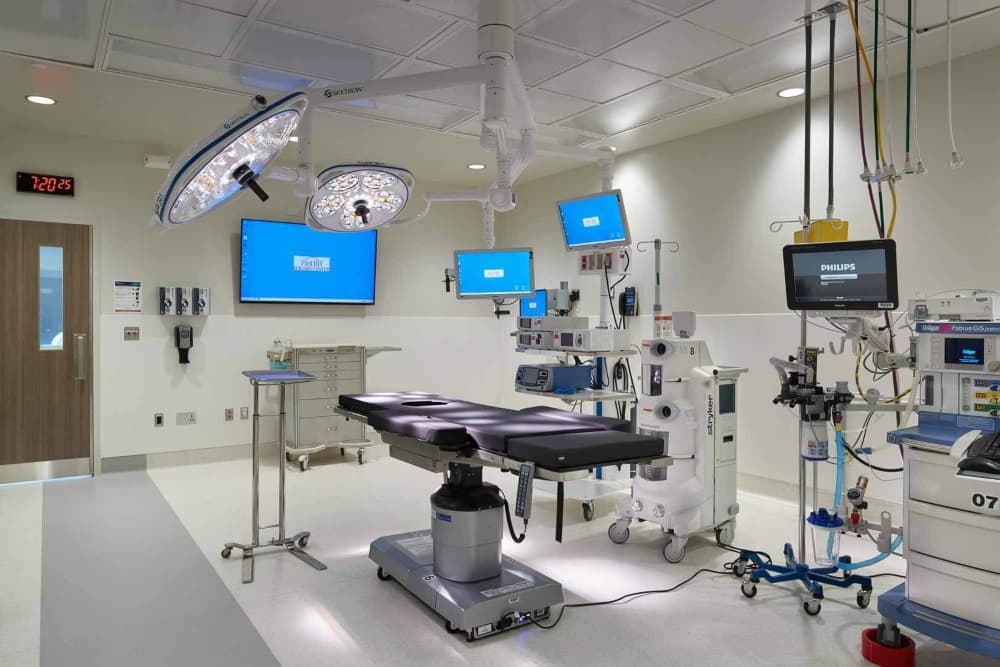 Healthcare & Critical Environments
Surgery center — operating rooms, PACU & sterile core
Fully equipped operating rooms with surgical booms and integrated power, plus post-anesthesia recovery (PACU) and a sterile processing core — the essential electrical systems a surgical suite depends on.
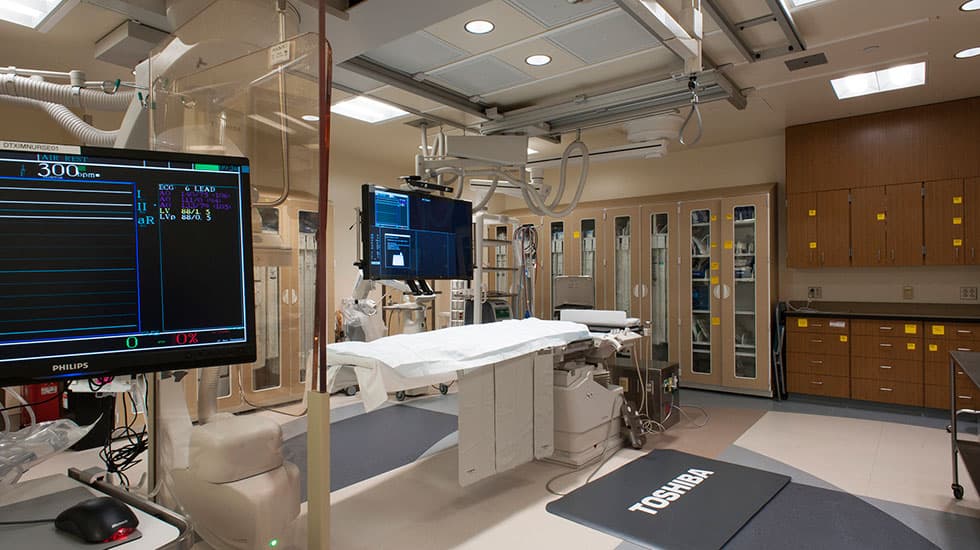 Healthcare & Critical Environments
Heart & vascular center — EP and cath labs
Electrophysiology and cardiac catheterization labs with ceiling-mounted imaging systems, isolated power, and the equipotential grounding these interventional-cardiology spaces require.
Hospital imaging & surgical center — EP labs, CT, MRI
Multi-phase work across a major hospital campus: electrophysiology labs, CT scanner and MRI suites, and an outpatient surgery center — executed in an occupied, operating facility.
Frequently asked
Questions buyers ask us
What is an isolated power system in a hospital?
An isolated power system supplies a patient-care area through an isolation transformer whose secondary is not connected to ground. Because the supply is ungrounded, a single line-to-ground fault cannot drive hazardous current or trip the circuit, so power continues while the fault is annunciated for correction. It is used in operating rooms and other wet procedure locations to protect patients from shock and to keep procedures from being interrupted.
What does a line isolation monitor do?
A line isolation monitor continuously measures the impedance from each isolated conductor to ground and computes the total hazard current, the current a person would experience by bridging a faulted conductor to ground. A green lamp indicates a safe condition; a red lamp and audible alarm indicate the hazard current has reached the trip threshold, typically 5 mA. The alarm is informational, signaling that the last equipment connected should be removed, not a command to shut down power.
Is isolated power required in every operating room?
NEC 517.20 requires that a wet procedure location be protected by either isolated power with a line isolation monitor or GFCI protection, unless the facility's governing body documents that the space is not a wet procedure location. Operating rooms are almost always classified as wet procedure locations, and because a GFCI trip would interrupt a procedure, isolated power is the standard choice. The determination is made through a documented risk assessment by the governing body.
What is the difference between isolated power and GFCI protection?
Both protect against shock in wet locations, but they respond to a fault differently. A GFCI trips on the first ground fault and de-energizes the circuit. Isolated power tolerates the first fault, keeps the circuit energized, and alarms so the fault can be corrected without stopping work. Where an unexpected loss of power would itself be hazardous, such as during surgery, isolated power is preferred.
Why does isolated power need special grounding?
Ungrounded supply limits the current a fault can drive, but safety also depends on equipotential grounding. NEC Article 517 requires a reliable, redundant equipment grounding path and bonding of conductive surfaces in the patient vicinity to a common reference, so no meaningful voltage difference can develop between two objects a patient or clinician might touch at once. Without that bonding, small fault currents could still appear as a dangerous touch voltage.
How is an isolated power system commissioned and maintained?
At commissioning we verify transformer polarity and voltage, inject a calibrated fault impedance to confirm the monitor alarms at the correct total hazard current, and measure and document reference grounding continuity and equipotential bonding resistance. Because the failure modes are silent, NFPA 99 and accreditation expect periodic re-testing of the alarm threshold and grounding impedance over the system's life, supported by the baseline records handed over at turnover.
Bid invitations & estimates
Planning isolated power for a procedure suite?
We work with general contractors, healthcare facilities, developers, and property managers across Washington. Send plans and we'll respond quickly.